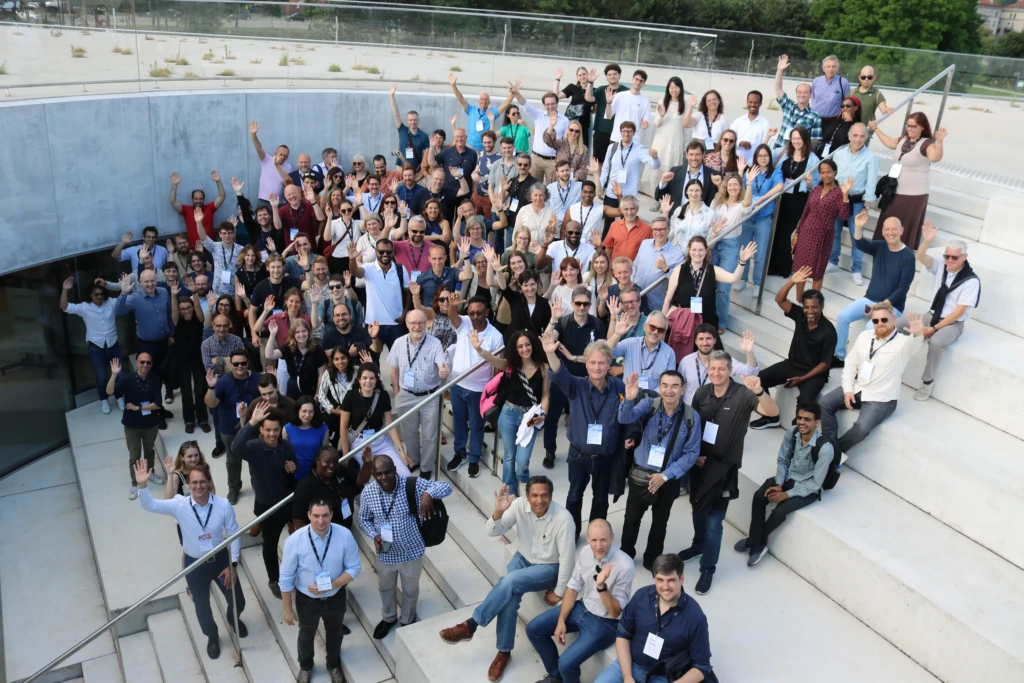




From 29 June to 3 July, Kaunas University of Technology (KTU) hosted the 23rd ECMI Conference on Industrial and Applied Mathematics, one of Europe’s leading events in industrial and applied mathematics. Held in Lithuania for the first time, the conference brought together researchers, academics, doctoral candidates, students and industry professionals from across the world to strengthen collaboration between academia and industry and explore mathematical solutions to today’s most pressing challenges.
The conference was organised by the Faculty of Mathematics and Natural Sciences at KTU, the only ECMI Educational Centre in Lithuania. According to Prof. Audrius Kabašinskas, Chair of the Organising Committee and Professor at KTU’s Faculty of Mathematics and Natural Sciences, hosting the conference was an important international recognition for both the University and the Lithuanian industrial mathematics community.
“The ECMI Conference is much more than a scientific event. It brings together a community dedicated to solving real-world challenges faced by industry, business and society through mathematics. We are proud that this community gathered in Kaunas this year, giving us the opportunity to showcase not only KTU’s research excellence but also Lithuania as a country that values international scientific collaboration,” says Prof. Kabašinskas.
Mathematics Addressing Today’s Challenges
Over five days, participants explored the latest developments in industrial and applied mathematics through plenary lectures, mini-symposia and parallel sessions.
The conference featured internationally recognised keynote speakers from the Netherlands, Italy, Poland, Germany, Spain, the United Kingdom, the United States and Lithuania. Topics ranged from causal inference in medicine and modelling of neurodegenerative diseases to topological data analysis, plasma fusion, nonlinear dynamical systems, artificial intelligence, energy transition and financial risk management.
Alongside the plenary programme, researchers presented their latest work during parallel sessions and mini-symposia covering a broad range of research areas in industrial and applied mathematics.
Bridging Mathematics and Industry
A distinctive feature of the ECMI Conference is Industry Day, dedicated to strengthening collaboration between academia and industry.
The programme opened with a presentation by Assoc. Prof. Leonas Balaševičius, Director of the Department of Research Affairs at Kaunas University of Technology, who introduced participants to KTU’s research ecosystem and opportunities for international collaboration. Assoc. Prof. Dr. Paulius Palevičius presented the workshops on mathematical solutions for business and industry organised by the Faculty of Mathematics and Natural Sciences at KTU.
Representatives from ILTE, Swedbank, Sodra, Telia, and Girteka shared practical examples of how mathematics, data analysis and artificial intelligence contribute to innovation and support decision-making in their organisations.
Participants also attended a lecture by this year’s EMS/ECMI Lanczos Prize for Mathematical Software winner, Prof. Garth Wells, who presented the FEniCS Project, one of the world’s leading open-source finite element computing platforms.
The day concluded with the panel discussion “Artificial Intelligence: Opportunities and Challenges for Science, Education, and Industry,” bringing together experts from academia and industry to discuss the opportunities and challenges presented by artificial intelligence in research, higher education and business.
Recognising Excellence in Industrial Mathematics
The conference also celebrated outstanding achievements in industrial mathematics through several prestigious ECMI awards.
Alongside the EMS/ECMI Lanczos Prize for Mathematical Software, awards were presented to the winners of the ECMI Best PhD Thesis Award and the ECMI Best MSc Thesis Award, recognising exceptional contributions by early-career researchers.
According to Prof. Kabašinskas, these awards not only acknowledge scientific excellence but also encourage young researchers to become active members of the international industrial mathematics community.
Science, Collaboration and Lithuanian Hospitality
Beyond the scientific programme, participants had the opportunity to discover Kaunas and experience Lithuanian culture. The conference included a Welcome Reception, a cultural excursion and the ECMI Social Dinner at Mokslo Sala Science Museum, providing valuable opportunities for networking and informal discussions.
“The value of conferences like ECMI extends beyond the lecture halls. Some of the most important conversations take place between sessions, where new ideas emerge and long-term collaborations begin. That is what makes the ECMI community so unique,” says Prof. Kabašinskas.
Hosting ECMI 2026 for the first time in Lithuania marks an important milestone for Kaunas University of Technology and the country’s mathematical community. The conference reaffirmed the essential role of mathematics in addressing complex societal, technological and industrial challenges while further strengthening international scientific collaboration.